The Hot Rooms
A hot room, invented separately in Finland, Istanbul and Japan.
Finland has the sauna. Istanbul has the hammam. Japan has the onsen.

All three run the same way: heat, something cold, then a long sit. Rome had a plunge pool, Finland has the lake, and Japan sits outdoors in whatever the weather is doing. What the heat and the cold do to the body is in Built for the Heat.
THE SAUNA
Finland has 3.3 million saunas and 5.5 million people, and nearly nine in ten Finns take one at least once a week. The oldest public sauna still running in the country is Rajaportti, in Pispala, a hillside of wooden houses above a lake in Tampere. It opened in 1906 and has barely changed since. The stove is a mass of masonry holding more than a ton of stones. Meter-long logs burn beneath them until they glow red, then the fire is put out, water goes onto the stones to clear the smoke, the flue lids are closed, and the heat holds through the evening.
Ari Johansson, chairman of the Pispala sauna association that runs it, had been going for almost 63 years when the Mint of Finland interviewed him in 2018. "You never need to be alone in Rajaportti sauna," he said. Titles and status, he added, are left in the changing room.
A sauna is a stove and a stack of stones, with the air between 176 and 194°F (80 and 90°C). Water hits the stones and becomes löyly, the steam that comes off them. When UNESCO inscribed Finnish sauna culture on 17 December 2020 it named löyly as the heart of the thing and repeated the old description of the room as a church of nature.
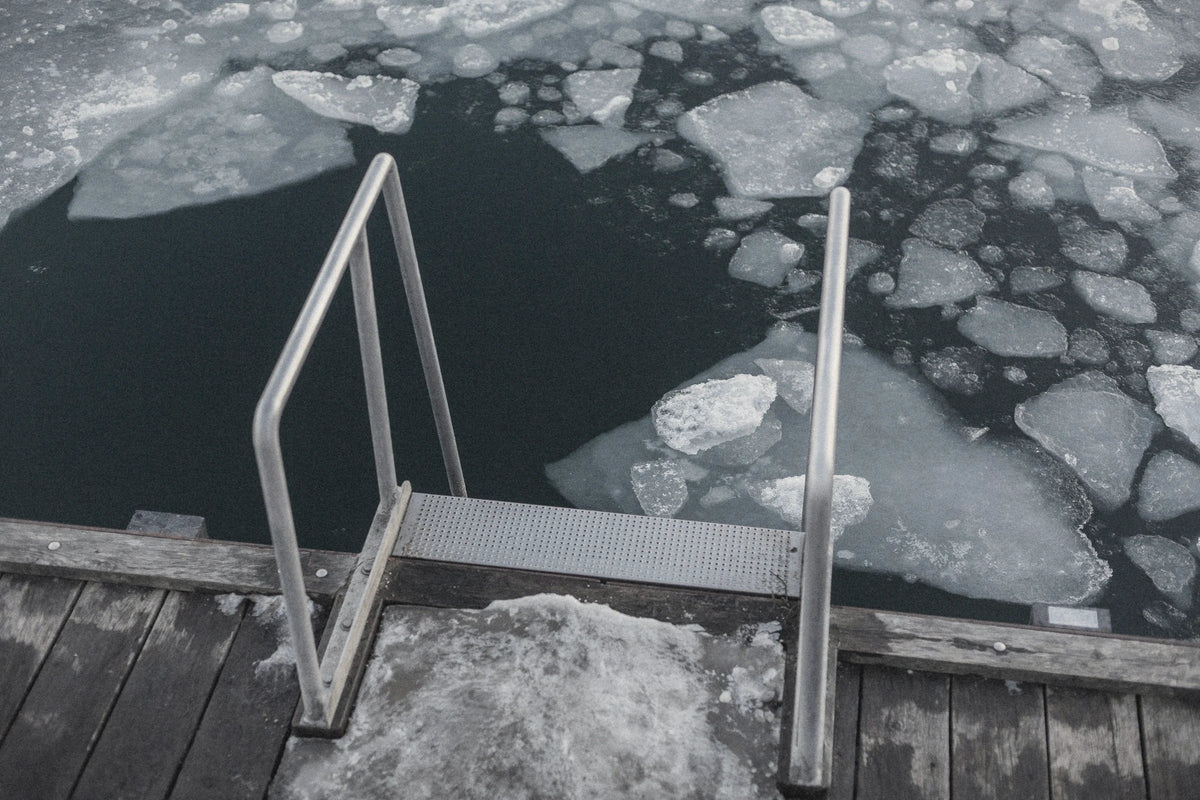
After the bench comes the water. You throw water when the room agrees and you leave when you have had enough, into the lake, the sea, the snow, or in the frozen months the avanto, a hole cut in the ice with a ladder set into it.

THE HAMMAM
The Umayyads took the Roman bath as they found it in the eighth century and kept it running. At Qusayr Amra, a small desert palace east of Amman, the bath keeps the Roman run of rooms, changing, warm, hot, and the dome of the hot room is painted with the zodiac, one of the oldest maps of the sky on any ceiling.
What the new rooms dropped was the pool. A Roman bather usually finished in a cold plunge. Islamic practice washes in running water, so the plunge gave way to marble basins with taps, and the cold room became the place you sit when it is over. Ottoman hammams were where business was settled and marriages arranged.
In 1556 Hürrem Sultan, wife of Suleiman, had Mimar Sinan build her one on the square between Hagia Sophia and what is now the Blue Mosque. It is 75 meters long, two baths laid end to end on one axis, their hot rooms back to back under domes pierced with small glass apertures, so the steam is lit from above in separate columns. It spent most of the last century as a warehouse and then a carpet showroom, and when the operator took it on in 2007 the estimate was a year and a half of restoration. "We saw that the building was about to collapse," its manager Hikmet Güvenli Bayındır told Anatolia News Agency after it reopened as a bath in May 2011.
Inside, you lie on the göbek taşı, the heated marble slab under the dome, in air of about 104 to 122°F (40 to 50°C), until you are sweating freely. An attendant comes with the kese, a coarse mitt, and scrubs hard enough to take off a layer. Then foam, then water from the basin, bowl after bowl, then the cool room and a glass of tea.
THE ONSEN
Japan defines the onsen by law. Under the Hot Springs Act of 1948, water qualifies if it leaves the ground at 77°F (25°C) or warmer. Cooler water qualifies if it carries one of nineteen listed minerals and gases.
You wash seated, thoroughly, before you go near it, because the bath is for soaking. The small towel never touches the water and sits folded on your head or on a rock at the edge. Hair stays up and voices stay low. The best version is the rotenburo, the outdoor bath, in winter: snow on the rocks, air at freezing, water close to 104°F (40°C), and you in the middle, warm from the neck down.
Jigokudani is a steep gorge in Nagano where hot water comes out of the rock, and a troop of wild macaques lives in it. In September 1962 the monkeys were first fed beside the Korakukan inn, and that winter the young ones started going into the inn's outdoor bath. In 1967 the park built them a pool of their own, fed by a spring 300 meters upstream, so that people and macaques would stop sharing a tub. The primatologist Kazuo Wada wrote down the first time he saw it, on 6 February 1963. Apples were being thrown to the troop and one landed in the hot spring and floated there. A one-year-old male went in after it, failed, tried again, got the apple and climbed out onto the edge. About five minutes later, with nothing in the water, he got back in and sat.